

I feel a tightness in my chest when I think about Edinburgh. A year ago, I was living in New York and branding startups. The idea of doing standup at the Fringe would have been someone else’s life. Then I made a move that made me rediscover myself, again, as every move tends to do.
If you want to know yourself, change your place.
Could it be Comedy
In my second month in Melbourne, I got taken on a date to a comedy show. As we were leaving the apartment, I said, “I feel like we’re emphasising our age difference with our clothes—you look super gen z and I look old even for a millennial.” And yes, sure enough, one of the comedians said to my date, “Hope that joke wasn’t embarrassing for you in front of your dad.” We thought it was hilarious. But what struck me was how the comedian actually felt embarrassed. It was surprisingly warm and considerate.
Afterwards, my date spoke to the room’s producer about performing. It inspired me. I went home, rehearsed a few times, recorded a set, and sent it to a couple of friends.
The feedback wasn’t a glowing endorsement. It was notes and redirections, while also encouraging and exciting. For a neurotypical without a traumatic upbringing, this would’ve been great. But I was devastated. I thought, ‘Ok, not for me then.’ I was considering committing to a career that won’t make money for a few years—if ever—and here I was, being given what I saw as an orange light.
However, I’m used to feedback. I approach things from an unusual angle, so while I come up with unique solutions, I’m always getting pointers. Back when I moved to New York, I was given an intense amount of feedback as I started a new career. But I was hungry, being offered great money for a creative job, and in the ‘greatest city in the world’ (for a few). I took it onboard and grew, going from constantly being schooled by my boss working on the Smirnoff global rebrand to, 9 years later, meeting no one in New York who could teach me anything.
With comedy in Melbourne, I’m now not even sure it was about the feedback. It was more, ‘Do I have it in me to start again?’
A couple of months passed, and I met an old acquaintance, Marc, at a bar, and he told me he runs Queer Comedy Collingwood. I made some jokes—not because I was pitching—but because I couldn’t help myself. He asked if I’d be interested in standup. His warm encouragement prompted me to show him that I could. I shared photos of my show in Sydney 10 years ago called ‘Open Rant Night.’


Despite feeling like I was starting anew, I actually have some experience in standup. I created, pitched, and hosted a night of 2-minute rants from anyone in the crowd, and it grew from a cocktail bar to a dedicated function room. The idea was to get more people casually talking politics but it veered into comedy quickly. By the second show, I was preparing punchlines.
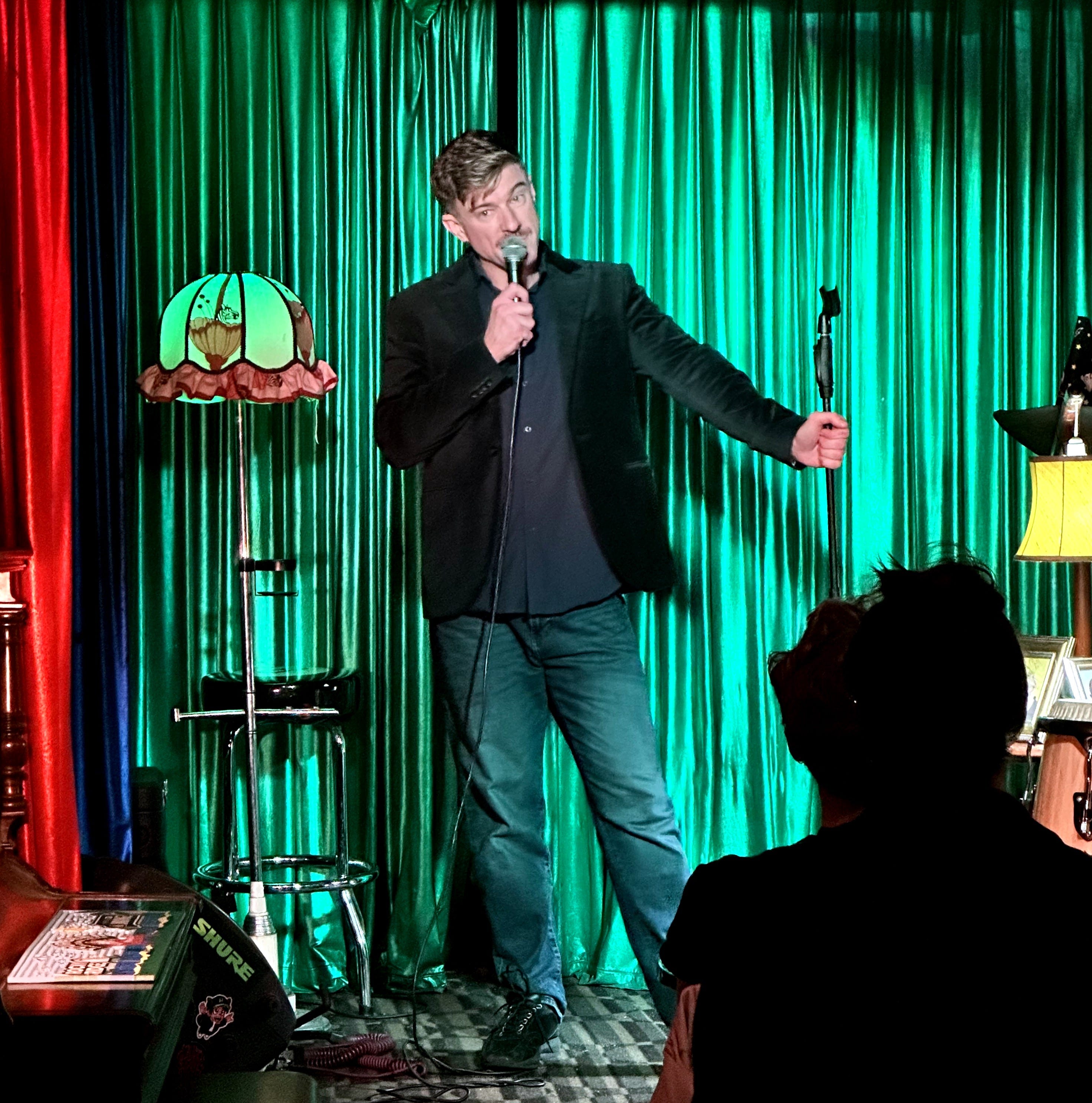
A month after meeting Marc, I was on the Queer Comedy stage. Following my 5-minute set, Marc as MC seemed surprisingly impressed, and shared with the crowd that it was my first time—to some applause.
It gave me a high I hadn’t felt in a long time. Maybe ever. I was ecstatic for two days, sharing joyously the feeling with everyone I talked to.
Since then, I’ve done about seven sets across two venues: Queer Comedy and Red Betty in Brunswick, which skews straight. I want to connect with everyone.
I’ve asked for mountains of feedback from comedians and friends. It’s been essential and I’m so grateful.
My first performance
Always was Comedy
I just needed unabashed positivity to get me feeling sure of myself. But I now realise why my friend didn’t do that. Because he knows me well, and thought I was much further along than I thought I was. He was telling me to run while I wasn’t sure I could crawl.
I’ve thought back a lot to a moment in a corporate 360 review in New York where everyone described me with the same word. I was hoping for “insightful.” I got “funny.” I was disappointed.
I now realise they’re not that different.
I’ve always been addicted to the power jokes have to: release pain, undermine illegitimate authority, and connect people in an experience. My time in corporate hasn’t been a divergence from comedy, it’s been a deep well of comedically ridiculous experiences.
There was another moment and another place that reminded me it’s always been this. Before my first time on the comedy stage, I flew up to Sydney for my niece’s christening, spending time with family in the neighbourhoods where I grew up. Sitting around the lunch table, my brother turned to me and asked, “What’s that line you use in moments like this? The thing you used to say?” It was, ‘Well, this is nice isn’t it?’ I would say it in a moment where people are almost pretending to enjoy something but are actually a bit bored. It always got a laugh. I realised comedy has always been around me in my deeply traumatised family.
Comedic Timing
It takes being in a new city to randomise events enough that you find yourself returning to a simmering-under-the-surface passion.
Literature tells us that when time travelling, one minor change will change the future. I suggest living life like that. But you’re also not in control of everything and luck matters. Therefore, my maxim is: Be ready to be lucky.
With these chance experiences in Melbourne, I got lucky to be on that date, I got lucky that I bumped into Marc, and I got lucky that he had started a comedy room only a year prior. But I was ready to make connections with different people, I was ready for something new, and I was ready to be more myself. Could it have happened at another time, in another place? Perhaps.
I had been interested in comedy in New York, but I found the scene hostile in that aggressive, braggy American style. I remember seeing a comedian after an open mic night, nearly in tears, saying she was so disappointed. I interjected and said I thought she was the best in the lineup. Seeing her was sobering because I had seen so many aggrieved, straight men at booked comedy shows, and here was a queer, thoughtful, different woman, and she was struggling the most. I saw myself and thought, ‘Absolutely not—I get enough of that kind of struggle and exclusion in corporate.’
Her name is Ashley Gavin and she’s now quite successful. I guess it could’ve been possible if I had more energy for the adversarial nature of New York. But I spent all that energy already.
Melbourne Comedy University
Every step of the way in Melbourne has been inviting. From the help from other performers, especially Freddie Arthur, Laura Bruce, and James G Warren, to what I call Melbourne Comedy University. It feels like a program, with clear tiers of open or booked, time slots at different lengths (the ‘tight 5’ up to a (hopefully tight) hour), and venues catering to every experience level, from a room at the back of a bottle shop (St Kilda Cellars) to a purpose-built multimedia cocktail lounge (Theory Bar)—and beyond.
There’s even a spreadsheet detailing 125 comedy nights spread out across this geographical huge city, with affordable space for so many. It lists which are weekly, fortnightly, or monthly, and who to reach out to and how.
Melbourne seems to be in a goldilocks zone: Big enough for a variety of venues and regular audiences, but small enough for a close community.
Audiences seem supportive too. The comedians sometimes lightly chide a half-asleep audience, but they don’t know how lucky they are to have an audience more attentive than New Yorkers, and more enthusiastic than Sydneysiders. Audiences appear to have a sense of responsibility, like they are a part of the scene as much as the performers are. They will push themselves to laugh a little more than the joke deserves, and even when they’re not laughing, they’re not dismissive, they’re just patiently waiting for the next line.
Fellow comedians have an optimism for inevitable success. At what level, I can’t say, but it’s still some kind of achievement people are hopeful for.
This flies in the face of tall poppy syndrome and Australian cynicism towards individuals with endeavour. ‘Never stick your neck out’, is the rebuke. Although I’m certainly not at the upper echelons so maybe I’ll experience that when I get there. But from down here, comedy seems to be the exception to Australian un-exceptionalism.
Going to Edinburgh
The encouragement to give everything a go has kept moving me. I reached out to the Queer Comedy group and asked about visiting Edinburgh during the Fringe. Gemma Francis got back to me with some tips and mentioned doing a show. I said, “God. I mean. Wonder if I could do a show. No no”. She came back all caps, “YES DO A SHOW. DON’T BE A LITTLE BITCH.”
Three days later, I was putting in an application.
I needed a name. Difficult given I’m still working on the content. I thought about it for a long time, explored some of the themes and concepts, iterated on some names, and ran a couple past friends. Then I realised the process was the name: I’m overthinking it.
Except given we live in a world of chronic under-thinking, “No, I’m not overthinking it,” is the statement I want to make. And the name of my first tour was born, along with a new website.

I’m now working on content to build the show. I’ve added some constraints to make it an achievable goal with the right kind of outcomes: It’s a small venue, so it will be easier to fill. It’s half an hour, so I’ll be leaving them wanting more. It’s in the middle of the day, so I’ll have people who can follow me on an intellectual exercise. It’s a short run of 7 shows, so I won’t burn out. And I’m coming up the weekend before to find friends and supporters. So yes, I’m overthinking it.
The place you live can control you in ways you aren’t aware. People think they can live wherever and not be limited. I’ve been in the wrong place, and pushed past my limits to the detriment of my health. Because most of the time, we’re just limited by where we are.
So incredibly inspiring 😊