Self-driving cars could drastically reduce road fatalities, saving hundreds of thousands of lives every year. But just one fatality is unacceptable because we don’t like a different kind of intelligence making the decision. One car dragging a woman 6 meters was enough to shut down an entire company—never mind that she was only on the ground because a human hit her. A technologist said that while we think AI makes stupid mistakes, AI would think—if it did think—our mistakes are shockingly stupid.
ADHD is a lot like AI in that it’s a different kind of intelligence, which, if tolerated, could (and has in the past) massively improve our world. But ADHDers do incredibly “stupid” things all the time. In fact, ADHD is so commonly thought of as just being stupid that people with intellectual disabilities are misdiagnosed with ADHD. And people with ADHD are assumed to have intellectual disabilities, like me.
Road trip: I’m writing this while on a road trip from Melbourne to Sydney
Part 1: The Classroom
When I was ten, I went to an elite private high school with grades 5 through 12. In the first year, there was an exam that would determine students' placement for the following year. We would be assigned to one of five classes, and there was a clear hierarchy. They used a colour system to try to hide it, but we all knew. The lowest level was called Brown. In hindsight, that isn’t that well hidden. My friends made fun of them, which I didn’t participate in, but I did nothing to stop them.
It would come to be the class I was placed in. And not just that, I was taken out for extra remedial help with a smaller group. Odd, I thought, that we would be slowed down to catch up. I now realise my naivety: There wasn’t any hope of catching up.
I still remember the feeling of my friends discovering I was in the remedial class. I remember their slight levels of compassion. In the short time I knew them, we had become close. I had visited their houses, and we had watched Tales from the Crypt and listened to the Smashing Pumpkins. However, there was a realisation now that I mustn’t be like them because they were placed in the highest-level class together. They mostly felt confused, or even deceived, like I had been pretending. I noticed them checking my reactions more closely when telling a story, as if to wonder, ‘Is he even like us?’
I also remember the moment of the exam that put me there. After it finished, I was trembling, because I knew the mistake I had made. As people filed out of the room, I hung back to explain to my teacher. On the multiple-choice answer sheet, I wrote the answer to the sample question, and so every response was off by one. Surrounded by the dark wood panelling of St. Patrick’s College, I still remember his disinterested, pitying face. He almost shrugged, and I’m not even sure he said much except that the exam is over. He thought I deserved the grade I got for making such a… stupid mistake.
I didn’t mention it to anyone else after that confirmation that I should be ashamed. I knew I was different because I would daydream or miss jokes, and this experience, along with others like it, would cement the idea that the world believed different was bad.
Thankfully, my family moved, and I was settled into a smaller school that didn’t have enough students for stratification. I lost touch with my friends almost immediately. And yet I remember writing letters to my primary school friend, Brett, despite it having been two years since we last saw each other. Class separation meant more than temporal.
I blame those friends a bit, especially since they felt quite comfortable making fun of kids in the lower-level class. But they were ten years old: Where else should they get their signals from if not adults with an objective measure? With a recognised system for determining the competency of people’s minds?


Part Two: The Clinic
Psychiatrists are much like those teachers, but for adults, and this has hit me hard again with my move back to Australia from the US. GPs (primary care doctors) and psychiatrists have told me I need to go through the diagnosis of ADHD entirely afresh.
The process is about three months and, including GP visits, costs around $2,000. Not only is it long, it’s excruciating, with questions designed for children. Literally, because adult diagnosis is a retrofitted version of childhood diagnostics. They ask questions like, “Do you get out of your seat when you’re not supposed to?” No, I don’t, because I doodle on a notepad and that’s how I channel my movement. That is, I’ve adapted. It’s like they did a find and replace for “classroom”, “teacher”, and “homework” with “boardroom”, “colleagues”, and “work tasks.”
If you had to design a process to frustrate the ADHD mind, you would design what psychiatrists have designed for diagnosing ADHD. It involves a lot of reading about very boring process details, irrelevant questionnaires, repetitive interrogations about the specifics of past events, and requires consistency in behaviour.
This would be easy for a neurotypical person, who is not put off by boredom and is comfortable responding to the checklist questions, giving the expected answer without any extraneous details. I know people who easily got Adderall for university exams, and they look at me baffled when I say that the first time I got diagnosed as an adult in the US was hard. One said, “You just tell them what they want to hear.” That actually never occurred to me. I always thought it would be best to explain my experience, so they can decide whether it aligns with their diagnosis.


Those with ADHD tell a familiar story of the difficulties of adult diagnosis, with some giving up. One psychiatrist commented to a friend, ‘Well, you have a job and a stable marriage, so it doesn’t matter.’ There are also misdiagnoses leading to devastating consequences, like a psychotic episode on the wrong medication, such as with Ben Grubb. And even after a psychiatrist correctly diagnosed him with ADHD, they refused medication. Now with his correct diagnosis and medication, he’s finally hopeful of living his best life, or as he put it, “<insert happy ending here>.” There are countless stories of people having difficulty getting an adult diagnosis, such as Matilda Boseley, who wrote a book on her experience, saying, “…my therapist missed it, my doctors missed it, but TikTok figured it out in a couple of weeks.”
If it were easy for someone to get a late diagnosis for ADHD, it should be immediately disqualifying. If it was hard and drawn out, it should never be questioned again. These anecdotes, and my experience of getting diagnosed several times, lead me to believe that psychiatrists are probably both overdiagnosing and underdiagnosing ADHD.
The irrelevant questionnaires are the depression/anxiety questions, which they ask every time you mention ADHD. They are concerned with the comorbidities of depression and anxiety, but this concern is like focusing on the embers of a fire instead of dealing with the gas pipe fueling it.
I actually love how my anxiety has helped me cope with being Undiagnosed-ADHD. Concerned about forgetting an event? No matter—I’ll just be on hyper-alert constantly for every event, checking my calendar hourly. Worried about saying the wrong thing at an event? No matter—I’ll just track everyone’s emotional state and try to please them with what they want to hear. Worried about accidentally answering the practice question? No matter—I’ll just put in extreme amounts of effort into every work task, overdelivering constantly until I burn out.
As Andy Bull’s song ‘Keep on Running’ says, “I try so hard it isn’t funny.” It really feels like an ADHD anthem about how hard we work to fit into a muggle world. So, yes, psychiatrist, I have anxiety. Well done. Can we now focus on the forest instead of the trees?
Another requirement from a psychiatrist that just made me cry was for reports from primary school and my parents, detailing ADHD behaviour from that time. The idea that I would keep any reports as someone who is neurologically hard-wired to live in the present is painfully ignorant. And my parents’ remembering my behaviour in the simple, checkbox way that psychiatrists require it is ridiculous, not least because one, if not both, has ADHD (it’s as genetic as height).
The diagnostic questionnaires for ADHD ask about consistent behaviour, no matter the environment or motivation. Motivation is actually the key difference for ADHD. We are driven by INCUP: Interest, Novelty, Challenge, Urgency, and Passion. Neurotypicals are driven by what you see everywhere in the world, from prisons to promotions, that is, Rewards and Consequences.
We enjoy rewards and try to avoid negative consequences, but we’re not driven by them. Neurotypicals can be energised by the idea of money alone. We’re energised by the idea of using money for a holiday. Similarly, we’re not demotivated by the prospect of persecution if we have interest, urgency, or passion. It makes sense that every revolutionary leader would have had ADHD: The ability to sense people’s feelings, and the motivation to get it done—personal consequences be damned.
So when I’m answering the question, “How often do you avoid or delay starting tasks that require sustained mental effort?” It misses the motivation. If it’s a task I’m interested in, the answer is never. If it’s a task I’m not interested in, every time.
But the psychiatrists continue with their questions that infect the thinking of others in healthcare who look up to them:
“How often do you have difficulty sustaining attention in tasks or play activities?” Either none or a lot.
“How often do you get easily distracted by extraneous stimuli, even during tasks that interest you?” Depends on the stimulus. If it’s a song on repeat for 4 hours, no distraction, but if it’s a pair of keys sitting slightly awkwardly in my pocket, constantly.
“How often do you fail to give close attention to details or make careless mistakes in work or other activities?” The judgment in this one is worth noting, “careless”, implying that we don’t care, but aside from that, what if your work doesn’t require close attention to details?
The most absurd request I saw from a psychiatrist was for a drug test. Recreational drug abuse is a key risk factor for people with ADHD. So if they are abusing drugs, they need help more than most, with the correct medication rather than self-medication like cocaine. The drug test should be to prove there is recreational drug use, and send those patients to the front of the line for treatment.
It was also just offensive: The presumption that because I want prescription medication, I am a drug addict. I picked up this sense from psychiatrists that they are concerned about how much we want stimulant medication. I’m not surprised they’re suspicious because it must be unusual for psychiatrists to see patients happy with their medication. This says so much about the medication they usually prescribe and should raise questions.
Neurotypicals using ADHD medications recreationally is primarily the reason for the scrutiny. But this is where psychiatrists could be our advocates, making access easier with monitoring from more accessible health professionals. Instead, the ANZ College of Psychiatrists discouraged empowering GPs to help with prescriptions and diagnosis: “Psychiatrists are uniquely trained to assess, diagnose, and manage ADHD.” Reading that aloud, I can’t keep a straight face, it’s so patently ridiculous.
It was my GP who raised ADHD with me because she was late diagnosed herself. She mentioned a podcast about a woman’s late diagnosis for me to listen to, sending me on a journey of self-discovery that I’m forever grateful for.
Part Three: The Culture
If I were a conspiratorial type, I would say that psychiatrists hate ADHDers. From the very beginning, they held us in contempt with the most inaccurate name for a condition. ‘Attention Deficit’ is the exact opposite of what people with ADHD experience, which is excess attention on everything. What they meant by deficit was a lack of attention on them.
Other names for the “impairment”, as psychiatrists would like to describe it, have been suggested. Variable Attention Stimulus Trait, or VAST, is one. But it’s a non-psychiatrist, Thom Hartmann, who came up with the most helpful, explanatory term: “Hunters”. When listing all the abilities ADHDers have, or ‘symptoms’, they make for a great hunter: Constant attention to all information, such as a twig breaking as much as a river gushing; Preferring constant movement; Obsession with novelty, discovering what’s just around the riverbend; Ignoring injuries when on the hunt; Calm in a crisis; And higher risk tolerance.
To be fair to psychiatrists, Hunters would always find it hard to hide our lack of admiration because we are innately better at observing people. Hunters notice everything at once, like a flat wall of information, where an eye twitch is as important as what someone is saying. I imagine neurotypicals see information in peaks and troughs. For instance, ‘Hello, my name is Jill,’ is a peak, and Jill running her finger behind her neck is a trough. I would remember her as ‘Finger-on-Neck Woman’ because it is the more novel detail that is worthy of processing.
Despite this, I would say we’re not good at reading people when we are personally involved. We assume people’s discomfort is about us, having had so many correcting signals as children of our natural behaviour. It’s like a Greek tragedy—we’re a kind of Cassandra who can see the future but isn’t believed—in that we can sense others’ vibes instantly but don’t believe ourselves to not be the problem. Of course, I now realise most people are battling crushing insecurities and hardly thinking of others at all.
Building on their lack of noticing, conversations with psychiatrists can feel like checklists. I am surprised that they always want a direct, specific answer, because in my experience of market research, this is rarely where the truth lies. Direct answers are always what people want you to think.
The clearest demonstration of the uselessness of direct answers is vodka brands. Vodka, by law in the US, can’t have any “distinct character, aroma, taste or flavor.” In blind taste tests, people consistently fail. But what people tell me is that they can taste the craftsmanship, or the French grapes, or the potatoes, or the extra filtration. What they mean is: It says I’m rich (Crystal), or it says I like nice things often (Grey Goose), or it says I’m practical but not cheap (Tito’s), or it says I’m ready to get drunk (Smirnoff). No one has ever answered this question directly.
Thinking they understood this, I would tell psychiatrists that in high school, I got grades of around 95% or around 60%. When a teacher handed me a prize for being in the top 1% in the state for economics, he was actually distraught, “I don’t understand you, Clinton. How can you get this, but you don’t put in any effort for your assignments?” Psychiatrists glaze over when I tell this story. They’re waiting for my answer to the question, “Did you have good grades in high school?” And they’re not sure how to interpret this confusing, both-sides-of-the-coin anecdote. I would feel for them if this wasn’t the point of their job—I’m not telling this story to my barista.
After that story, the psychiatrist told me it is very hard to diagnose ADHD, and many psychiatrists struggle with it. That’s when it clicked for me that there’s a problem with the profession. Because I think most people would hear that story as textbook ADHD, and even the fact that I told a meandering story is indicative enough.

I don’t expect there are many psychiatrists with ADHD. Their long and tedious accreditation process would be an instant turn-off for Hunters who are already better at the job’s key requirement. We have few advocates on the inside.
Hartmann didn’t just name ADHDers ‘Hunters’, he also named neurotypicals ‘Farmers’. A Farmer works slowly, methodically, enjoys predictability, sows and waits for reward, and doesn’t have a constant need for novelty.
If I were to pathologise Farmers in the same way Hunters have been, these would be my top concerns:
Slower decision-making
Slower pivoting
Low curiosity
Hypofocus
Lack of broad awareness
Need for trivial tasks through habit
Higher dishonesty
Groupthink
Highly anxious in crises
Contentment with suboptimal situations that erode productivity or enjoyment.
That last one I’ve termed ‘Neurotypical Decay.’ It’s when they sit in a restaurant with bad lighting and don’t notice their slowly creeping agitation. Or when they stay in a loveless marriage for decades.
But I don’t want to pathologise Farmers. I see them as doing things I’d rather not do, and I’m thankful.

It’s no wonder Hunters have turned to social media to gain compassion, a better understanding of themselves, and learn how to embrace and work with their traits. It’s such an indictment on the psychiatric profession that something so toxic as social media has provided so much comfort.
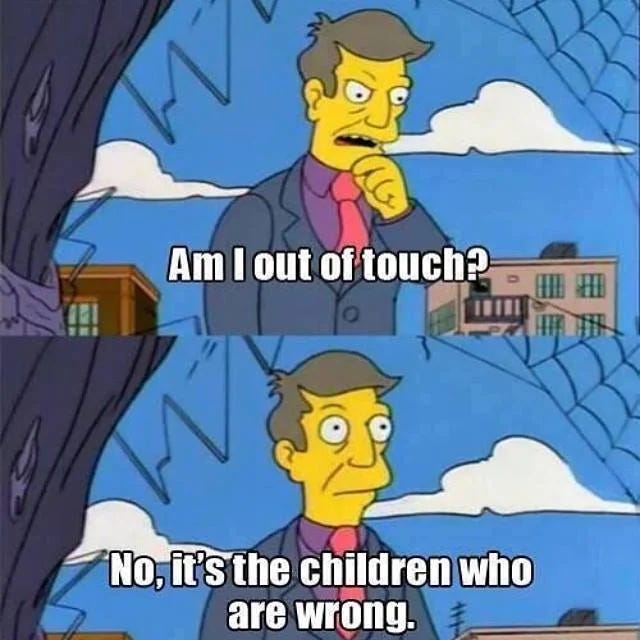
A psychiatrist who gets called up to explain ADHD on the TV is Patrick McGorry. He writes in a tabloid newspaper that, “This consumer-driven phenomenon is both dramatic and fascinating, and is fuelled at least in part by social contagion or ‘fashion’.” The pseudo-science vibe to his statements makes them seem legitimate, but it really just comes from the fact that, as he earlier states, one in 20 is a lot of people to be diagnosed. He’s the Principal Skinner of psychiatry.
It wouldn’t be the first time psychiatrists saw a large number of people report an experience and ignore it. Sigmund Freud discovered that basically all women had been sexually abused at some point. He received pushback when he first revealed that, and so he settled on the much less brave conclusion that they were making it up. History certainly rhymes.
I have an estimate of the number of people who would be Hunters, and it’s based on a hypothesis rather than a vibe. Imagine two hunter-gatherer groups, one with only Hunters and the other with only Farmers. The disadvantage to the Farmer group would be substantial, leading to starvation and likely extinction before long. But the Hunter group would excel. Hunter-gatherer groups would therefore always have a certain number of ADHD members to maintain a competitive edge. Given the size of hunter-gatherer groups was about 20 to 30 people, they would need one to two ADHD super-hunters in active service, one to two younger ones on the way, and one to two older ones on the way out. For groups of 20 to 30, that’s 20%.

If you think you may be a Hunter, seek out someone who already identifies as one. I was thankful to have a GP and a close friend who both mentioned it. I’ve diagnosed people within 10 minutes of meeting them, going on to describe parts of their lives that they thought no one would ever know or guess. “Are you, like, a witch?” Someone joked. In the past year, I’ve diagnosed about 15 people, with perhaps two being incorrect, but others saying they’ve been told that before, and at least three have gone on to get ‘formal’ diagnoses from psychiatrists, for whatever that’s worth.
The problem is probably bigger than poor psychiatrists, who themselves are just victims of the structure of healthcare that’s more accurately sickcare. Because, as McGorry says, it’s only ADHD if it “…Meets the essential criterion for a disorder, namely that the symptoms interfere with, or reduce the quality of, social, school, or work functioning.”
Preventative care is not part of the remit. It’s all about dealing with problems once they’ve destroyed lives.
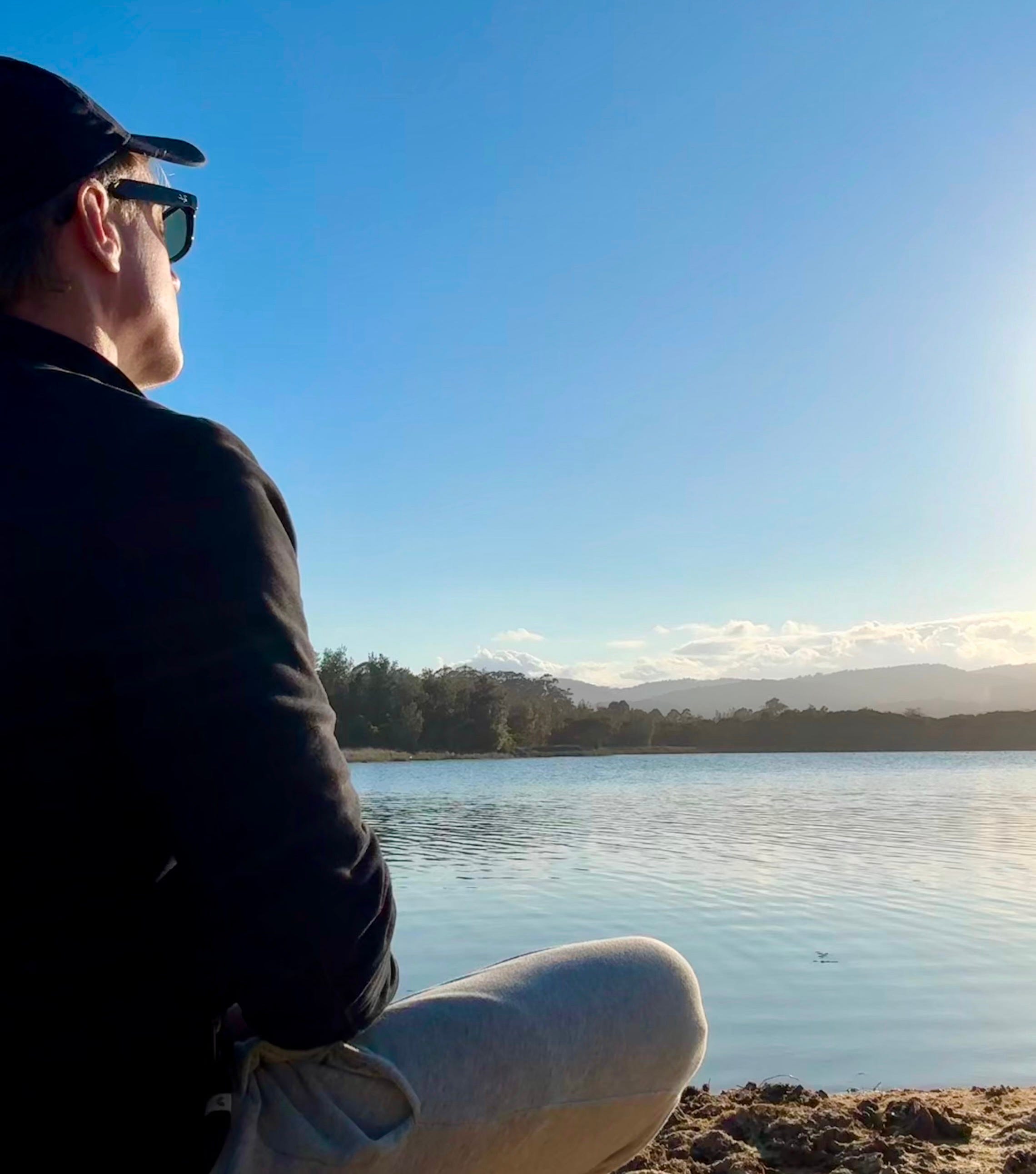
The Lagoon in Mollymook, where I took a meditation break
Much like self-driving cars. Imagine if we put the same effort into making human drivers slightly better—such as driver training, idiot-proof road design, policing, and drunk-driving policies—as we do into making the environment better for self-driving cars? But we prefer to exert extreme effort to achieve a small improvement rather than put in less effort and be more creative to achieve a 90% improvement.
It’s a society-wide problem not to have the imagination of exceptionally better outcomes. So ADHD intelligence is often sidelined, not just by psychiatrists but by many people. Psychiatrists could be a part of the ADHD equation, but they don’t deserve their current role as chief arbiter, given the experiences of so many. I’m encouraged by New South Wales pushing ahead with empowering GPs to diagnose ADHD, against the wishes of psychiatrists.
Whenever I suspect someone has ADHD, my first step is to share with them clarifying and empowering clips from social media. It turns their initial dismay into excitement at the possibilities for unleashing their true nature, working with their abilities rather than against them. My favourite is the cute couple with the double-meaning handle of “ADHD Love”.
I don’t know what life I could have lived if I didn’t have to spend so much of it being misunderstood. But I know it gave me an obsession with understanding itself. Every job I’ve had has been focused on it, helping people understand themselves, each other, and the world. It’s truly joyful to almost see tears in people’s eyes as they say I’ve understood their life’s work better than anyone before. Every time I experience that, the ten-year-old me, being misunderstood in a cold classroom, is restored a little more.