

Big decisions are rarely one thing. One prompt, perhaps, but unless you’re an amoeba, multiple reasons make it make sense. I’m leaving New York inspired by a visit to Australia, prompted by a divorce, expedited by politics, encouraged by friends and family, and freed with remote work. It seemed logical, but is my New York dream at an end? Because, to quote Lorde as she runs through the streets of New York in her latest track, “What was that?”
Liza’s lyrics also kept coming into my head: “If I make it there, I’ll make it anywhere.” Did I make it here? A savant in psychology friend of mine said, “I've got to say I've always thought NYC is the ultimate Second Stage city. It's literally part of the marketing.” He’s referring to the concept in the book, “The Velvet Rage,” which outlines three stages of gay men dealing with their identity: denial, seeking validation, and self-acceptance. The iconic Liza line is a promise of validation like no other. Lena Dunham’s character in “Girls” believed it, giving herself a pep talk when hoping for a validating return to her hometown, “You’re from New York, you’re inherently interesting.” Surely satire, but I never know with that show.
The brand prestige of New York is real. Everyone you meet here is trying something. With varying degrees of ambition, but trying nonetheless. It is inspiring.
To make it here is to overcome struggle, as is the heart of every good story, and New York is a great story. “I think I’ve earned it,” said someone whom I asked if he was a New Yorker. No one has said, “I think I’ve earned ‘Californian’.” Some say 20 years is when you’ve earned it, and then there’s the added tier of Native New Yorker. I find this hierarchy nauseating and prefer the Fran Leibowitz definition: “A person who lives in New York.” Some people overcome struggle quicker, some never need to and are here forever; time isn’t much of a measure.

When I hopped off the plane at JFK with a dream and more than a cardigan in an unusually snowy January 2018, I didn’t know the form of that dream. Yet I believed that if I could make it anywhere, it would be here, because making connections is my personality, and this is the place for it. On my previous visits, first as a vacation in 2013, and then a couple more scouting visits to stress test whether I could live here, I was continually amazed at how easy it was. Not just because Americans are great at connection—I would say the best in the world—but because New York is an on-top-of-each-other town.
American socializing is peach-esque, with a soft, penetrable outer layer before an almost uncrackable core; they open up to the potential of connection, but deeper friendships are more difficult. Australian socializing is the opposite, being much more coconut, with a hard outer shell, but once you’re in, there are no more tests. These metaphors were developed in the 90s by business consultants training bemused Americans deployed around the world and getting cold receptions. Made even colder when coconuts interpret this unmoored positivity as deception, thinking something like, ‘No one can be that nice without knowing me.’
Australians call Americans fake. And they’re right, because optimism is faking positivity until it manifests as destiny. Australians fake negativity, which in social situations means being playfully mean. The purpose is to draw out vulnerability by testing your defensiveness.
If you need physical evidence of the difference, American bars, of which there are plenty within easy subway access in New York, have bar counter seating. Peaches squish together to get to know each other. Hardly any bars in Australia have bar seating, as people fortify their coconuts with a table or booth.


Standing on a boardwalk looking at the ocean in a hotbed of connection, Fire Island, I remember the most American approach, “Excuse me, do you have a lighter?” I replied, “No, I don’t smoke.” “Me neither,” he said, “I don’t even have a cigarette. I just wanted to say ‘hi’.” This pickup line demonstrates the fearlessness to seem stupid that is sometimes necessary for an introduction. Australians are terrified to a stifling extent of seeming stupid (however, in recent years, Americans could have a scooch more hesitation). Another time in an elevator, someone said, “Heading to the roof?” Well, yes, I thought, since it is the only stop left and I’m still in the elevator, but instead I said, “Yes! Looking for somewhere to read in the sun. Yourself?” Another in a Soho House pool started with a conversation involving me, but not to me, “Hey!” he said to his friend, “You’re splashing people,” and gave a general, “Sorry!” He wasn’t splashing me at all, but this is the public narration from a peach (I didn’t respond, having decided we didn’t have much in common given their conversation, which was an acceptable non-response response to their general statement).
There’s a formula. Narrate anything to the within-earshot target, make a tiny request, or apologize for nothing much. The insignificance is the point, as it doesn’t entrap people into a required response, which makes the response chosen, indicating reciprocal interest. And from the insignificant, it can be escalated to useful, one increment at a time, gauging interest along the way. For people approaching me, it’s always been, “Where’s your accent from!” There is excitement from the abundance of small talk that can unfold from an accent. Another avenue is a positive comment about the shared experience, “How nice is this pool!” Never negative (I’ve tried) because the positive context imbues optimism for the interaction. Or a throwaway compliment, “I like your shirt!” From there, if the responses are equally enthusiastic, you can increment your way into medium talk: “Where did you buy it? Is that where you’re from? Me too! Whereabouts? What do you do?” And before you know it, you’re talking about a job vacancy at their company.
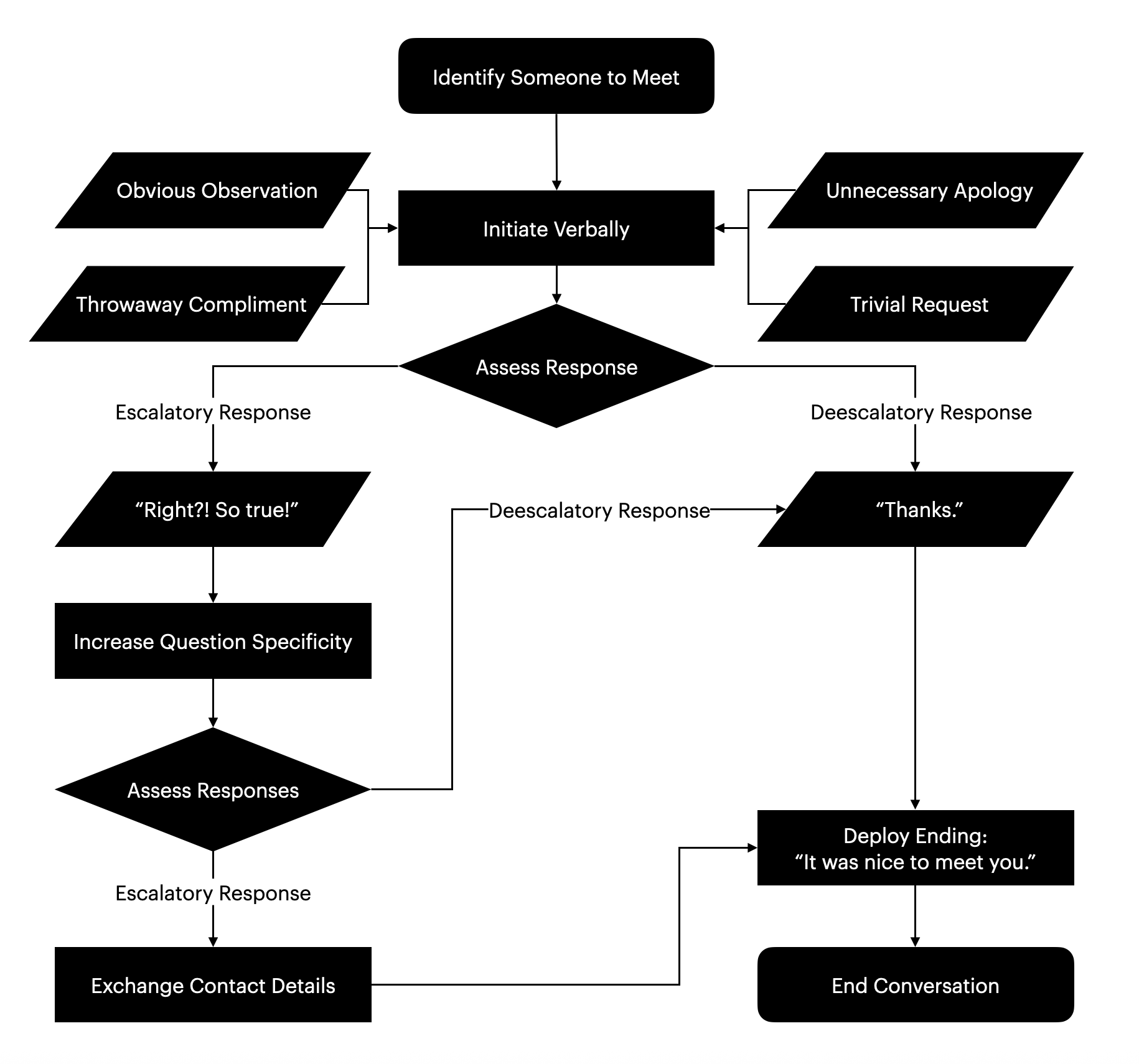
The insignificance and increments allow for a feature that Australians are completely incompetent at: Exiting. If you don’t think you have much in common, you can choose not to respond to their first comment if it's general enough, or at least dial down the enthusiasm. Americans are looking for these signals in a muscle memory dance. They even have a magical phrase which means, ‘I am finished with this conversation and would like to leave now.’ I don’t think Americans are at all conscious of this, which is the beauty of social technology, because it’s in the water. The phrase goes like this, “It was really nice to meet you!” The degree of enthusiasm correlates with the desperation to leave. If you add a shoulder touch, it means you really want to leave. I was once demonstrating this to someone, and they thought I was actually leaving, the response being so conditioned. The problem with coconut cultures isn’t that they don’t know how to start conversations; it’s that they don’t have a mutually agreed-upon method of ending them.
My prophecy that New York would be suitable for a connection-obsessive was self-fulfilled within weeks. On March 4, 2018, I wrote to friends back home, a month after arriving: “I've had remarkable luck in New York, and it’s thanks to the kindness of strangers; ready to open themselves to a new friend.” I went on to add a reflection of how much harder I found it in Sydney, meaning I was a constant, not a variable, “It was such a problem in Sydney that I consciously tried to overcome it for people new to the city.” Maybe I earned ‘Sydneysider.’
The luck I was referring to was securing a delightful share apartment in my favorite neighborhood, the East Village, with a caring flatmate I just met, growing my inner circle of fascinating friends of artists of all media, marketers who cared about their craft, and people with jobs I never knew existed, like a specialist in textiles. And a life-changing job, “I know you applied as a writer, but you’re a better strategist,” said my new boss in classic New York directness. It took me two weeks after landing in New York to land this contract for the global rebrand of Smirnoff, where I collated and analyzed international research on how the newly number two vodka in the US could prevent that happening elsewhere (and it worked).
I came to this contract through a contact at a party, after a series of yeses that weren't my preference. I didn’t like the club, and I can’t remember the people I went with or who invited me to the after-party where I met the contact. I wrote to friends back home again to detail my ‘say yes’ approach with a list of things I said yes to in my first couple of months, along with my internal monologue:
“I always say ‘yes’:
Yes, I’m free this weekend even though I have a tonne of errands.
Yes, I want to go to a pumping dance party with a steep cover charge which I later realize is because no one orders drinks because everyone is on Molly, gyrating to unrecognizable, melody-less music.
Yes, I want to go bowling even though I suck at it and it’s objectively boring.
Yes, I want to play laser tag even though I’m well over 30.
Yes, I want to go to an expensive seafood brunch, blowing my budget on my least favorite food at the worst time of day to eat it.
And finally, and perhaps worst of all, Yes, I want to go to a spin class.”
I also talked about my focus on finding and connecting with nodes, “This is going to sound exploitative and strategic, but when I identify these people, I make time for them, and give little concern to our compatibility.”
After Smirnoff, I got a contract for brand work on Rockefeller Center through a connection I made in a booth at an ice hockey game (again, not a thing I wanted to say yes to). Strange to brand an icon that has a clear story, but it’s about finding what doesn’t flow in the narrative. In their case, literal flow, because I introduced them to the concept of wayfinding, well-established in the less-talkative Australia where asking for directions makes you seem stupid. I’m no Liza (yet), but my contribution is now obvious, and importantly for wayfinding, not obvious, everywhere on that landmark.
By year two, I moved from contracts to a permanent role in a dream position, under a mentor-like boss who struck a delicate balance between instruction and empowerment. I developed original methodologies and refined stories to crack clients’ creativity blocks and get them to own their identity. CO OP Brand Co. referred to itself as an academy due to its alumni's tendency to advance to more senior roles. And they were right.


I became a strategy director at one of the big agencies next and eventually had my own business. Specializing in startups because I was drawn to their pace, I believed that if I could connect directly with founders, I could take their brand to more creative places. In the last two years, I’ve done the most creative and fulfilling work of my life. I got a nonprofit to reflect the urgency of a tech company. I got a primary care brand to live their revolutionary spirit of challenging insurers. I got two boutique consultancies to redefine themselves as change agents. And so many more. We’ve branded 23 companies in 2 and a half years. My business is appropriately called The Connected.



It’s only in writing this that I think: ‘Okay, that’s a dream you’ve made.’
Like me, Lorde moved to New York about 7 years ago, which is when she recorded Melodrama. One of the tracks, “Green Light,” which is about rebirth, became my theme tune. That sentiment is calling me again. Australia is inspiring with once-in-a-century infrastructure investments across the three major cities. People can still talk about politics without violence. I’ve also changed, because although I’m returning to the land of coconuts, I know like never before that there is juice just under the husk. And while some of my favorite people are in the US, I’ve come to miss my favorite people in Australia. Finally, all the American problems have sapped my enthusiasm for working here. I just don’t feel the dream anymore. So I’ll take my growth as an endpoint and decide that I did ‘make it’. Because dreams don’t really end, you just wake up.
another great article...I guess living in Sydney, how you described Australians just feels normal to me - but this is why I love meeting American's when I travel - they're fun and easy to talk to.
I'd like you to know that I didn't know until right now that Miley was saying "a cardigan."